
06/03/2026
Usage of Machine Learning to correct the Sea Surface Wind forecasts Numerical Weather Prediction model with Scatterometer observations
-
In the context of the OSI SAF Visiting Scientist Program, Evgeniia Makarova from the Barcelona Expert Center (BEC), Institute of Marine Sciences (ICM-CSIC), Spain, worked on using machine learning to correct persistent wind biases in ECMWF’s ERA5 reanalysis weather forecasts. This work took place in 2024–2025 and was supervised by Marcos Portabella (BEC, ICM-CSIC) and Ad Stoffelen (KNMI).
-
-
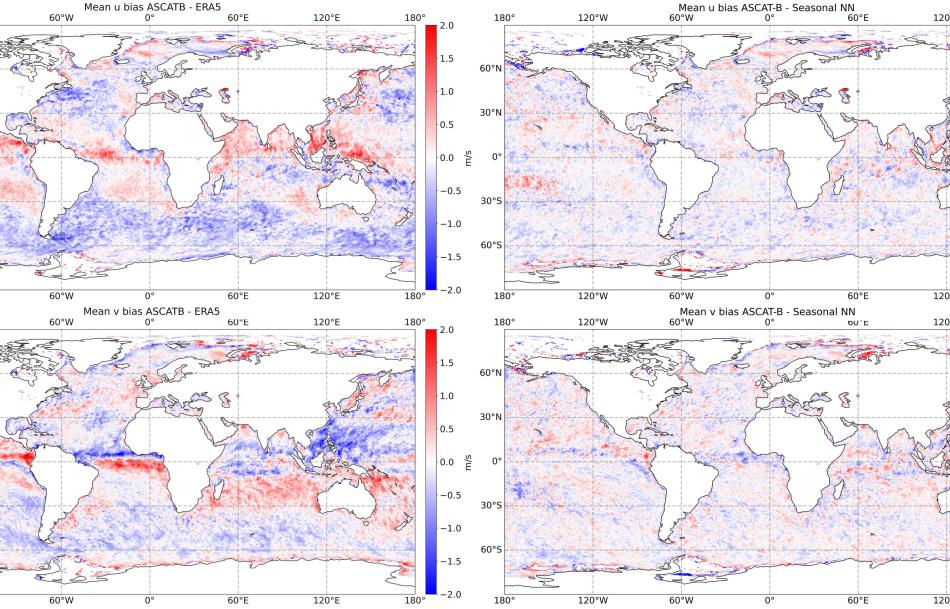 Mean bias (m/s) of ERA5 (left) compare to NN-corrected ASCAT-B (right) for January 2023
-
-
Figure: Mean bias (m/s) of ERA5 (left) and NN-corrected output (right) against ASCAT-B for January 2023, for both the zonal (top) and the meridional (bottom) U10S components.
-
Ocean surface winds
Accurate ocean surface winds assessments are essential for ocean modelling, marine weather forecasting, and climate research. Numerical Weather Prediction (NWP) models such as ECMWF's ERA5 are widely used sources of surface wind data, but they are known to exhibit persistent, geographically structured biases. These include excessive westerlies in mid-latitudes and easterlies in the tropics, and insufficient meridional convergence toward the Intertropical Convergence Zone (ITCZ). These biases are linked to unresolved air–sea interaction processes, sea surface temperature gradients, and ocean current effects.
Existing bias correction methods, such as the ERA products and the Copernicus Marine Service products, are effective, but rely on the concurrent availability of scatterometer observations, limiting their use in forecasting applications or during periods of sparse satellite coverage.
-
Objectives of the study
A previous OSI SAF visiting scientist study (OSI_VSA22_01) demonstrated the feasibility of machine learning for ERA5 wind forecast bias correction, using a limited three-month dataset. The key objective in this study was to train Fully-connected Feed-forward Neural Networks (FCNNs) on five years of ERA5 atmospheric and oceanic variables, including surface current data from CMEMS to predict and correct persistent wind biases, which corrections can subsequently be applied in wind forecasts.
Report conclusions
The results demonstrate that ML-based corrections significantly reduce ERA5 stress-equivalent wind biases, while preserving the spatial variance of the wind fields. On a global scale, error variance reductions reached approximately 13% when validated against ASCAT C-band scatterometers and around 9% against independent Ku-band HSCAT instruments. The highest improvements — up to 16% — were observed in extra-tropical regions. Monthly models, trained on data corresponding to each calendar month, outperformed the all-year model, particularly in the tropics where seasonal variability is strongest. Although large-scale bias structures were substantially mitigated when compared to ASCAT scatterometers (Figure 1), some residual discrepancies remained when compared to Ku-band scatterometers. These are attributed to possible ERA5 forecast diurnal biases and differences in sampling between platforms, related to the higher rain sensitivity of Ku-band systems, their distinct local observations times, and viewing geometry. This requires additional analysis and will be the focus of follow-up work.
-
Benefits for the SAF
- This work provides an alternative to existing NWP bias-correction methods based on simple difference statistics. The by-scatterometers trained models require only NWP and ocean current inputs at inference time. Consequently, the approach removes the dependency on real-time scatterometer data availability that currently constrains existing correction methods. This makes ML-based bias correction applicable even during periods of sparse or absent satellite coverage, significantly extending the conditions under which wind quality improvement can be achieved. After fine-tuning the model on the operational ECMWF Integrated Forecasting System (IFS) data, it could further be applied to operational wind forecasting.
- The improved NWP wind stress outputs are of direct interest to the ocean modelling community and marine service providers, for whom persistent forecast wind biases have a measurable impact on the quality of their model outputs and services.
-
About this study
Find here the complete report for this Visiting Scientist Activity: On the use of machine learning to correct NWP model sea surface wind forecasts with scatterometer (ERASTAR AI2)
-
Authors
Evgeniia Makarova - Institut de Ciències del Mar (Barcelona)
Marco Portabella - Institut de Ciències del Mar (Barcelona)
Ad Stoffelen - Koninklijk Nederlands Meteorologisch Instituut (De Bilt)