
30/03/2026
Analysis and validation of SeaWinds-derived coastal winds
-
In the context of the OSI SAF Visiting Scientist Activities Program, Giuseppe Grieco from the Italian Institute of Marine Science (ISMAR-CNR) worked on the validation of coastal wind retrievals obtained with the Sea- Winds pencil-beam radar cross sections corrected using the “Noise Regular- isation” methodology. This work, done in 2024, was supervised by Marcos Portabella (ICM-CSIC) and Ad Stoffelen (KNMI).
-
-
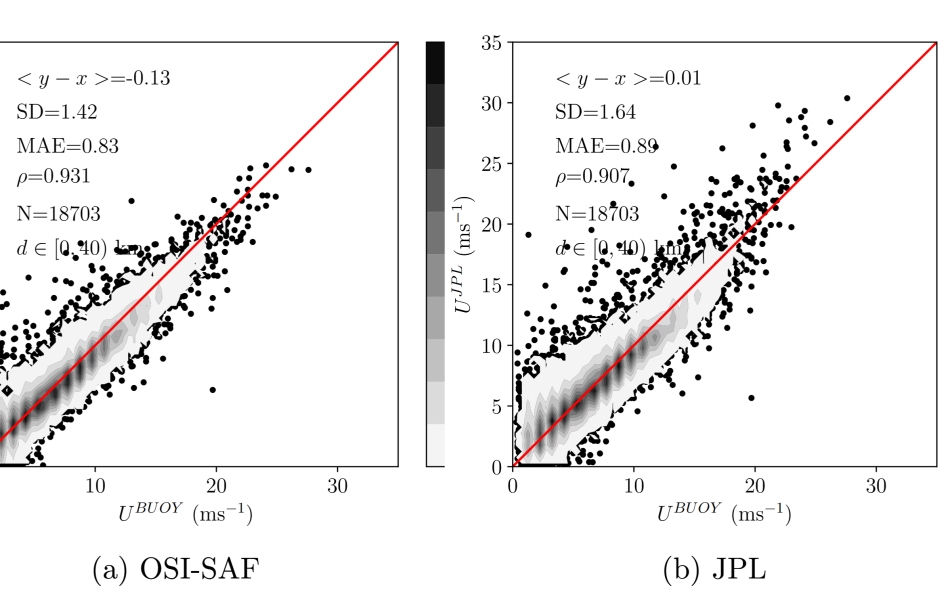 ontour plots of 2D normalized histograms of OSI SAF and JPL vs buoy wind speed within 40 km from the coast
-
-
Figure: Left (right) column: contour plots of 2D normalized histograms of OSI SAF (left)and NASA/JPL (right) vs buoy wind speed within 40 km from the coast. Bias, standard deviation (SD), Median Absolute Error (MAE), correlation coeffi- cient (ρ), number of samples (N ) and d are also reported.
-
Objectives and framework of the study
Coastal winds remote sensing is fundamental for many scientific and civil applications. Scatterometer-derived winds represent the users’ prime choice among satellite-derived winds, thanks to their unmatched accuracy and sampling features. Nonetheless, they suffer from land contamination within ≈30 km from the coastline. “Noise Regularization” is a new methodology developed in the context of the OSI-SAF Visiting Scientist Activities Program to mitigate land contamination in SeaWinds radar cross sections. This study presents a validation of the wind retrievals against the homologous product developed at NASA/JPL, buoy measurements and ECMWF Reanalysis 5 model winds for a period spanning the entire year 2007.
-
Report conclusions
The results of this study show that both wind products are high-biased at wind regimes lower than 3-4 ms−1 within 20 km from the coastline, while the JPL product also presents high biases at high wind regimes and farther from the coast. In general, JPL wind retrievals are much noisier than OSI-SAF. A thorough analysis of the OSI-SAF Maximum Likelihood Estimator (MLE) suggests that some residual land contamination is still present in SeaWinds radar cross sections. However, residual land contamination is higher in JPL than in OSI-SAF winds. It is envisaged that further land contamination mitigation can be achieved by de-biasing wind retrievals.
-
Benefits for the SAF
- This study confirms the OSI SAF developed coastal winds product from QuikSCAT has a more effective land-contamination mitigation methodology than JPL
- The scatterometers from the Chinese family Hayang-2 and the Indian ScatSat and OceanSat can benefit from this mitigation methodology
- OSI-SAF software processor for the correction of SeaWinds radar cross sections is publicly available and can help foster collaborations with Indian and Chinese partners.
-
About this study
Find here the complete report for this Visiting Scientist Activity: Analysis and validation of SeaWinds-derived coastal winds
-
Authors
Giuseppe Grieco - Consiglio Nazionale delle Ricerche (Naple)
Frederico Cossu - Institut de Ciències del Mar (Barcelona)
Marco Portabella - Institut de Ciències del Mar (Barcelona)
Jur Vogelzang - Koninklijk Nederlands Meteorologisch Instituut (De Bilt)
Anton Verhoef - Koninklijk Nederlands Meteorologisch Instituut (De Bilt)
Ad Stoffelen - Koninklijk Nederlands Meteorologisch Instituut (De Bilt)